

Chinese Neurosurgical Journal Highlights Gut–Brain Axis in Pituitary Tumor–Related Cognitive Decline
Gut Microbial Dysbiosis in PIT1-Lineage PitNETs and Its Link to Cognitive Impairment
Hormonal dysregulation and gut microbiota alterations as potential contributors to cognitive dysfunction
CHINA, March 9, 2026 /EINPresswire.com/ -- Pituitary neuroendocrine tumors (PitNETs) are commonly associated with visual disturbances and endocrine abnormalities; however, many patients also experience cognitive deficits, particularly in memory, attention, and executive function, which significantly affect quality of life. Despite increasing recognition of this burden, the mechanisms underlying cognitive impairment remain unclear. Traditionally, cognitive changes have been attributed to tumor mass effects or direct compression of surrounding structures. Emerging evidence, however, implicates hormonal dysregulation and the gut–brain axis, suggesting that intestinal microbiota may influence cognition through inflammatory, metabolic, and endocrine pathways.To bridge this gap, researchers from Kunming Medical University, led by Dr. Xingli Deng, conducted a prospective cross-sectional study to evaluate cognitive function in patients with PitNETs and examine associations among tumor lineage, hormonal abnormalities, and gut microbiota composition. The study made available online and published in Volume 11, Issue 33 of the Chinese Neurosurgical Journal on 30 December 2025. Dr. Deng explained the motivation behind the study, “By integrating neurocognitive assessment with endocrine profiling and microbiome analysis, we aimed to move beyond traditional explanations centered solely on tumor size and mass effect, and instead explore a more comprehensive, biologically grounded model of cognitive dysfunction in PitNET patients.”
This prospective cross-sectional study included 42 patients with PitNETs and 42 matched healthy controls. Cognitive function was assessed using the Montreal Cognitive Assessment (MoCA) before surgery and again three months postoperatively. Tumor characteristics, including volume and invasiveness on MRI, and pituitary hormone levels, were recorded. Tumors were classified as functional or nonfunctional and grouped by molecular lineage (PIT1 and SF-1). Fecal samples collected before treatment underwent 16S rRNA sequencing to characterize gut microbiota composition. Statistical analyses evaluated group differences and correlations between cognitive scores, clinical variables, and microbial profiles.
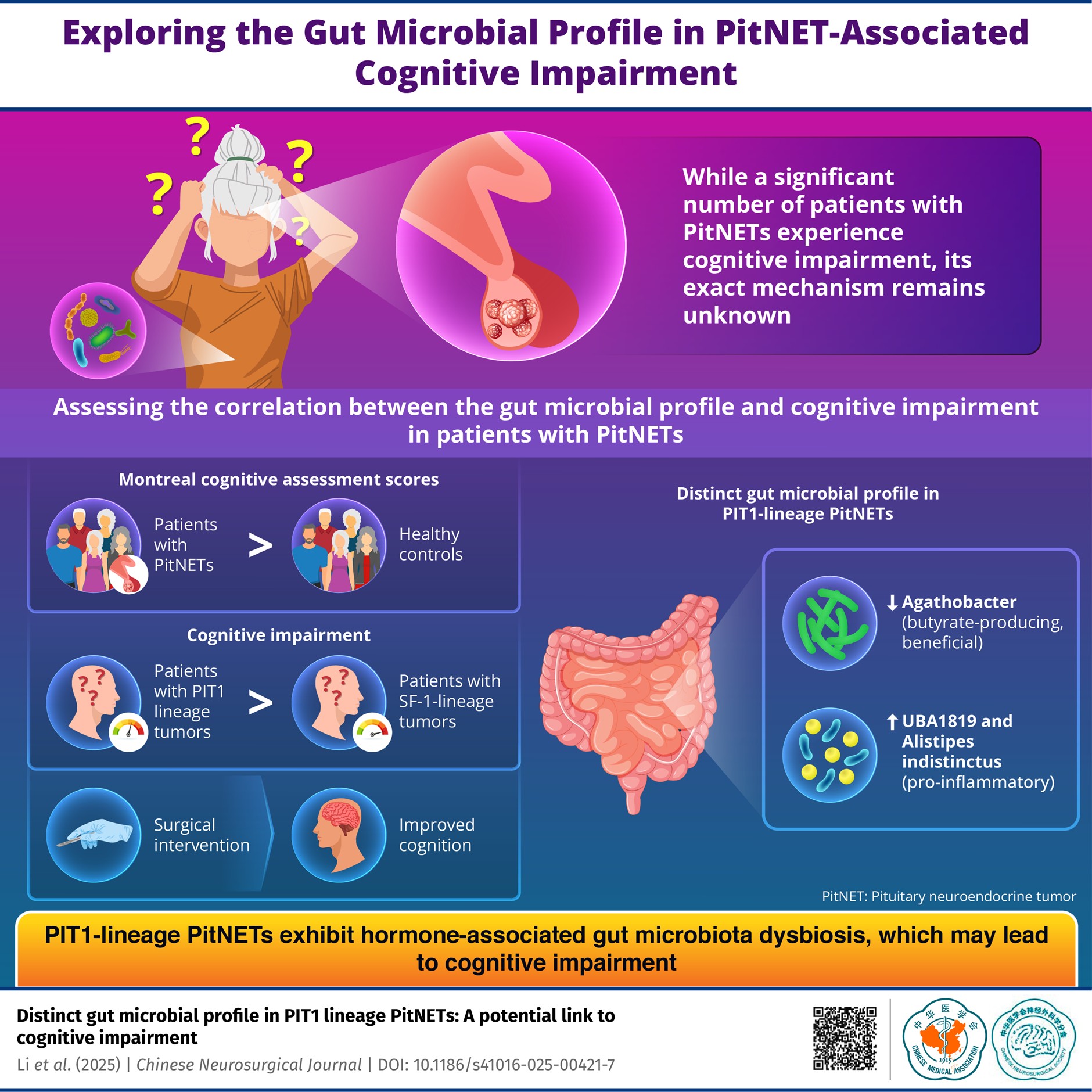
The findings were remarkable. “Patients with PitNETs demonstrated significantly lower cognitive performance than healthy controls, particularly in attention, executive function, and memory, with impairments more pronounced in functional and PIT1-lineage tumors,” noted Dr. Deng. Cognitive impairment was especially pronounced in patients with functional tumors, particularly those classified within the PIT1 lineage. Notably, tumor volume and invasiveness were not significantly associated with cognitive outcomes, challenging the assumption that structural mass effects are the primary drivers of neurocognitive decline. Importantly, cognitive scores improved three months after surgical tumor removal, accompanied by reductions in elevated hormone levels such as growth hormone (GH), insulin-like growth factor 1 (IGF-1), and prolactin (PRL). These findings support a potential endocrine mechanism underlying cognitive dysfunction and recovery.
Microbiome analysis revealed distinct alterations in gut bacterial composition among PitNET patients. Reduced abundance of the butyrate-producing genus Agathobacter, known for its anti-inflammatory properties, was observed, along with increased levels of potentially pro-inflammatory taxa such as Alistipes indistinctus and UBA1819. These changes suggest that inflammatory and metabolic pathways linked to gut microbiota alterations may interact with hormonal dysregulation to influence cognitive outcomes.
This study integrates clinical, endocrine, cognitive, and microbiome data within a well-characterized cohort, strengthened by pre- and postoperative assessments and household-matched controls. By linking tumor lineage and microbiota alterations to cognitive impairment, it moves beyond traditional structural explanations and proposes a multifactorial model involving endocrine and gut–brain axis mechanisms. However, the modest sample size and cross-sectional microbiome design render the findings exploratory. Larger longitudinal studies are needed to clarify causality and to determine whether microbiota-targeted interventions could meaningfully enhance cognitive outcomes alongside surgical management.
In conclusion, cognitive impairment appears to be common among patients with PitNETs, particularly those with PIT1-lineage tumors. Cognitive dysfunction is more strongly associated with hormonal dysregulation and gut microbiota alterations than with conventional indicators of tumor burden. Surgical intervention is associated with measurable cognitive improvement, and modulation of the gut–brain axis may represent a promising future therapeutic avenue. Collectively, these findings provide a comprehensive framework for understanding the multifactorial basis of neurocognitive dysfunction in PitNET patients and open new directions for integrated treatment strategies aimed at improving neurological function and quality of life.
***
Reference
Title of original paper: Distinct gut microbial profile in PIT1 lineage PitNETs: a potential link to cognitive impairment
Journal: Chinese Neurosurgical Journal
DOI: 10.1186/s41016-025-00421-7
About Kunming Medical University
Kunming Medical University (KMU), located in Kunming, is a leading medical university in southwest China. Founded in 1933, it has developed into a comprehensive institution dedicated to medical education, research, and healthcare services. The university offers undergraduate, postgraduate, and doctoral programs across clinical medicine, public health, pharmacy, and biomedical sciences. KMU is affiliated with several teaching hospitals, including the First Affiliated Hospital, which serve as major centers for clinical training and research. With a strong emphasis on scientific innovation and regional health development, KMU plays a vital role in advancing medical education and healthcare in Yunnan Province and beyond.
Website: https://www.kmmu.edu.cn/
About Dr. Xingli Deng from Kunming Medical University
Dr. Xingli Deng is a neurosurgeon and researcher in the Department of Neurosurgery at The First Affiliated Hospital of Kunming Medical University, Kunming, Yunnan, China. His work focuses on pituitary neuroendocrine tumors and related neurosurgical diseases. He has co-authored peer-reviewed studies on tumor biology, molecular mechanisms, and clinical outcomes, including research on tumor invasiveness and cognitive function in affected patients. His research integrates clinical practice with translational neuroscience, contributing to improved understanding, diagnosis, and management of pituitary and other neurosurgical conditions.
Funding information
This study was supported by the Special Foundation Projects of Joint Applied Basic Research of Yunnan Provincial Department of Science and Technology
with Kunming Medical University (No. 202101AY070001-081), Yunnan Provincial Basic Research Program Project (No. 202301AT070096), Yunnan Provincial
High-level Health Talents Program (No. L2025025), and “Xingdian Talents” Support Project of Yunnan Province.
Yi Lu
Chinese Neurosurgical Journal
+861059978478 ext.
luyi617@sina.cn
Legal Disclaimer:
EIN Presswire provides this news content "as is" without warranty of any kind. We do not accept any responsibility or liability for the accuracy, content, images, videos, licenses, completeness, legality, or reliability of the information contained in this article. If you have any complaints or copyright issues related to this article, kindly contact the author above.
